

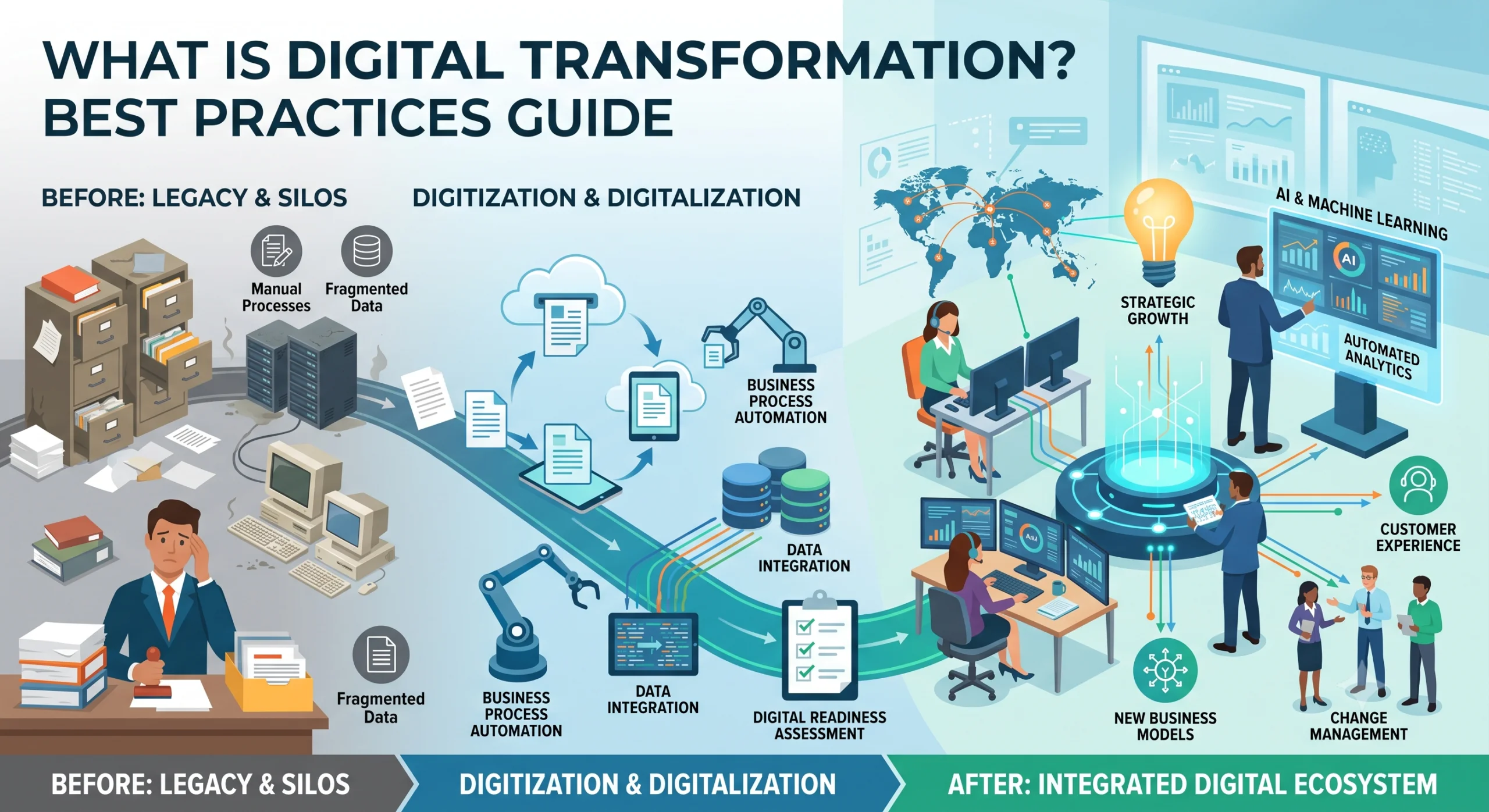
Digital transformation is one of those terms that gets thrown around so much it starts to mean nothing. Vendors use it to sell software. Consultants use it to sell services. Companies use it to describe anything they do with a computer. This guide cuts through that. We have built digital transformation projects for companies in Sri Lanka, including a major import-export company whose legacy system we replaced and integrated with their bookkeeping and HR systems. That work taught us what transformation actually involves, and what it does not. What Digital Transformation Actually Means Digital transformation is the process of using digital technology to fundamentally change how a business operates and delivers value. Not how it stores documents. Not which apps it uses. How it operates. The key word is fundamentally. If you scan paper invoices into PDFs, you have not transformed anything. You have moved the paper to a screen. If you rebuild your invoicing process so that invoices are generated, approved, sent, and reconciled automatically, and finance staff spend their time on exceptions instead of data entry, that is transformation. Transformation changes the work, not just the format. The Three Levels: Digitization, Digitalization, and Digital Transformation These three terms get used interchangeably, and that causes confusion. They are different things. Digitization is converting analog information to digital. Scanning a paper document into a PDF. Typing a handwritten ledger into a spreadsheet. The process does not change. Only the format does. Digitalization is using digital technology to change or improve a process. Instead of mailing invoices, you email them. Instead of tracking inventory in a notebook, you use a database. The process is reworked to use digital tools, but the underlying business model stays the same. Digital transformation is changing the business itself through digital technology. The processes change, the roles change, and sometimes the business model changes. A company that used to sell software as one-time licenses and now sells it as a subscription is not just digitalizing. The business has transformed. Most companies stop at digitization or digitalization and call it transformation. It is not. If your finance team still does the same work in the same way, just on a screen instead of on paper, you have digitized. You have not transformed. Common Mistakes Companies Make We have seen the same mistakes repeat across projects. Here are the ones that derail transformations most often. Starting With Technology Instead of Process The most common mistake. A company buys software first, then tries to fit their processes into it. The software dictates the process, instead of the process dictating the software. This fails because every company’s processes have reasons behind them. The way your operations team logs shipments, the way finance categorizes costs, the way HR tracks time, all of these evolved to handle real situations. When you force a new tool onto those processes without understanding them, you break things that were working and create new problems. The right order: understand the process, identify what is broken or wasteful, then choose or build technology that fixes those specific problems. Treating Transformation as an IT Project Digital transformation touches every department. When it lives in the IT department and gets treated as a technology rollout, it fails. IT can build and maintain the systems, but the people who do the work have to define what the systems should do. We have seen companies buy expensive platforms, hand them to IT to implement, and then wonder why adoption is near zero. The operations team was not involved. Finance was not involved. The tool does not match how they actually work. Transformation is a business project with a technology component, not the other way around. Trying to Do Everything at Once The big bang approach. A company decides to transform everything, sets a deadline, and tries to replace all systems and processes simultaneously. This fails for two reasons. First, no one can manage that much change at once. Second, when something breaks, and it will, you cannot isolate the cause. Was it the new system, the new process, the data migration, or the training gap? You will not know. Phased transformation works. Pick the highest-pain process, transform it, learn, then move to the next. Ignoring Data Quality New systems on top of bad data produce bad results faster. We worked on a project where the legacy system had years of inconsistent supplier records. Duplicates, misspellings, missing fields. If we had built integrations on that data without cleaning it first, every report and sync would have propagated the errors. Data cleanup is unglamorous and slow. It is also non-negotiable. No Change Management People do not resist technology. They resist change they did not ask for and do not understand. We added an employee ID selection step to an operations workflow as part of an integration project. The team pushed back because no one explained why. Once we involved them in the design and showed them how the data fed into productivity dashboards they actually wanted, adoption followed. If you do not plan for the human side, the technology side does not matter. Best Practices Start With Processes, Not Technology Before you evaluate a single tool, map your current processes. Find the bottlenecks, the manual workarounds, the places where errors happen. Those are your transformation targets. A good test: if you cannot describe the current process in detail, you are not ready to transform it. You are ready to disrupt it, which is different and usually worse. Get Buy-In From the People Doing the Work The people who do the work daily know where it breaks. They also know which proposed changes will help and which will create new problems. Involve them early. Not as a formality after you have decided, but as input before you decide. Show them prototypes. Listen when they say something will not work. They are usually right. Phase Your Approach Pick one process or one system. Transform it. Measure the results. Learn what worked and what did


