

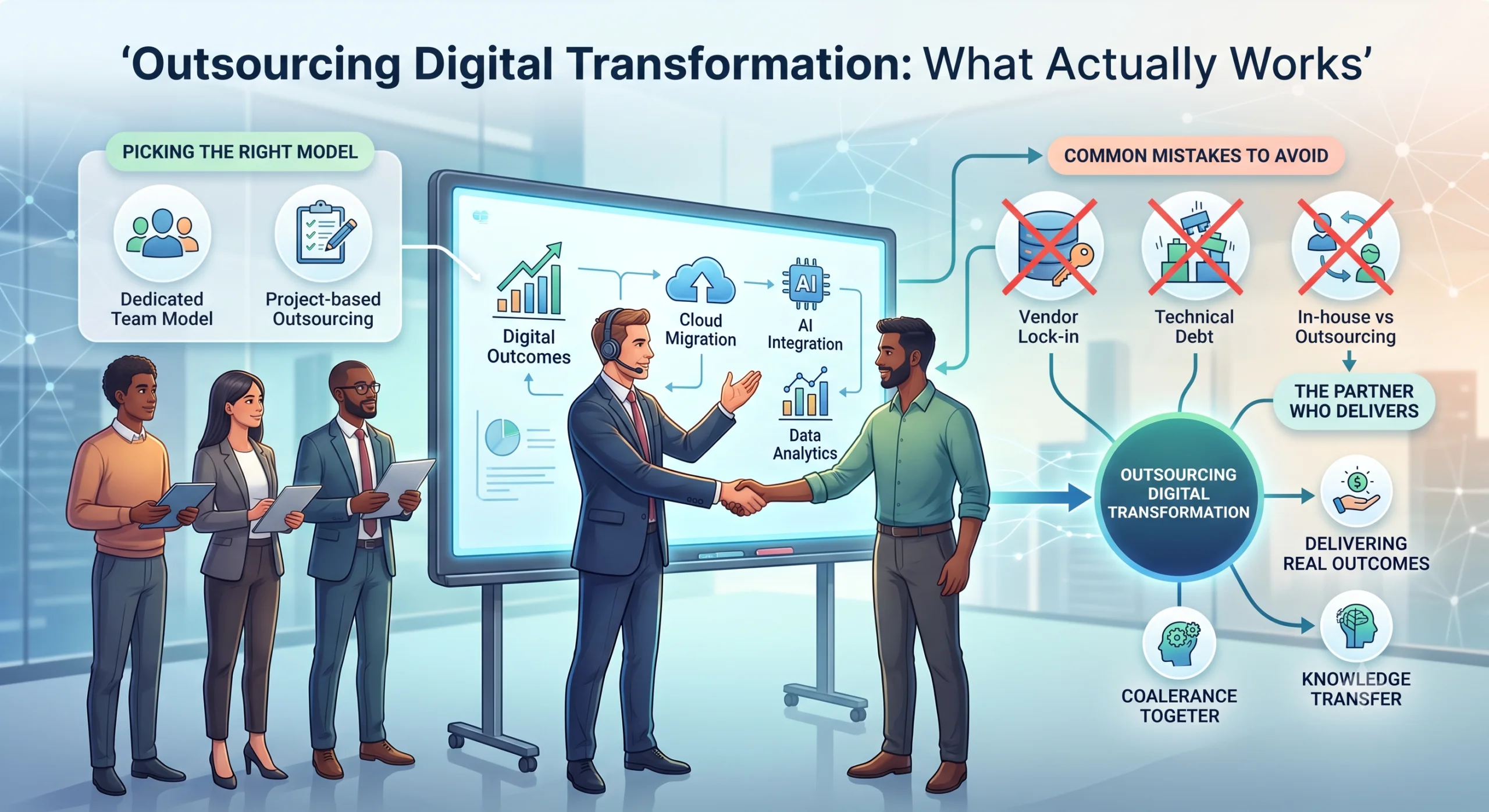
Companies outsource digital transformation for good reasons. They lack in-house engineering capacity. They need to move faster than hiring allows. They want to control costs instead of building a permanent team. These are valid motivations. The problem is that most outsourcing efforts fail before the first line of code gets written. We have seen it from both sides. As a Sri Lankan software company founded in 2023 by three engineers, Helixz Solutions takes on outsourced transformation work regularly. Some clients arrive with clear goals and strong internal ownership. Others arrive with a budget and a vague wish. The difference in outcomes is stark. This post covers what actually works when you outsource digital transformation, the mistakes that sink projects, and how to pick a partner worth trusting with your systems. Why Companies Outsource Digital Transformation The reasons usually fall into three categories. Lack of in-house expertise. Most companies do not employ specialists in cloud migration, API integration, mobile development, and data engineering all at once. Building that team through hiring takes six to twelve months. Outsourcing gives you access to people who have done this work before, across multiple industries. Speed. A dedicated external team can start within weeks. You skip recruiting, onboarding, and ramp-up time. For a company facing competitive pressure or an aging system nearing failure, that speed matters more than perfect cost optimization. Cost. Outsourcing to a market like Sri Lanka, where engineering talent is strong but rates are lower than North America or Western Europe, reduces spend without cutting quality. The math works when the work is well-defined. It falls apart when cost becomes the only factor in the decision. The companies that succeed treat outsourcing as a capability decision, not a procurement decision. They ask what skills they need, how fast they need them, and what outcomes they expect. Then they find a partner who can deliver. The Common Mistakes That Sink Outsourced Transformations Most failures share the same root causes. Here are the ones we see repeatedly. Treating It as a Pure Cost Play When the primary goal is spending less money, everything else suffers. The cheapest vendor wins the contract. Requirements get trimmed to fit the budget. Quality drops. The project either ships late, ships broken, or never ships at all. You save money on paper and lose far more in rework, delays, and lost business. Cost matters. It should never be the deciding factor above competence and fit. Not Defining Outcomes “We want to digitally transform” is not an outcome. “Reduce order processing time from three days to four hours by replacing the manual workflow with an automated system” is an outcome. Vendors cannot deliver what you cannot define. When the goal is vague, the vendor guesses, and the result rarely matches what leadership had in mind. Write down the specific business outcomes before you talk to a single vendor. Measure success against them. No Internal Ownership This is the most damaging mistake. A company hands the entire transformation to an external team and walks away. No internal product owner. No technical counterpart. No one accountable for decisions, priorities, or alignment with business goals. Outsourcing shifts execution, not accountability. You still need someone inside your company who owns the outcome, makes tradeoff decisions, and keeps the project connected to real business needs. Without that person, the vendor works in a vacuum and you get software nobody uses. Picking the Cheapest Vendor The cheapest bid almost always costs the most in the end. Low bids assume optimistic timelines, minimal scope, and junior engineers doing senior work. Change requests pile up. Deadlines slip. You either pay more to fix the problems or start over with a different vendor. Evaluate vendors on technical depth, relevant experience, and communication first. Consider cost after you have a shortlist of qualified partners. Outsourcing Models: Project-Based, Dedicated Team, Hybrid The model you choose shapes how the work gets done. There is no universal best option. There is the right option for your situation. Project-Based You define the scope, timeline, and deliverables upfront. The vendor commits to a fixed price and hands over the finished work. This model works well for well-defined projects with stable requirements. A marketing website rebuild. A point integration between two systems. A mobile app with a clear feature list. It fails when requirements are uncertain or likely to change. Digital transformation projects usually involve discovery and unexpected complexity. Every change becomes a negotiation, and the relationship turns adversarial. Dedicated Team You hire a team from the vendor that works exclusively on your projects. You manage priorities and direction. The vendor handles team composition, retention, and infrastructure. This model fits ongoing transformation work where priorities shift and the scope is large. You get continuity, deep knowledge of your systems, and flexibility to redirect the team. The cost is higher commitment, usually a minimum engagement period, and the need for strong internal product management. Hybrid A core dedicated team handles the main work, supplemented by project-based resources for specific, bounded tasks. A dedicated team builds the platform. A project-based team delivers a one-off migration or a specialized integration. This is the most common arrangement we see. It balances flexibility with cost control. The dedicated team carries institutional knowledge. The project-based resources handle work that requires specialized skills. How to Evaluate an Outsourcing Partner Choosing a partner is the single most important decision in an outsourced transformation. Here is what to evaluate, in order of importance. Technical Depth Ask for specifics. What systems have they integrated? What cloud platforms do they work with daily? Can they show you architecture they designed, not just code they wrote? A vendor that talks in generalities about “digital solutions” without concrete examples is a red flag. We are always ready to walk through past integration work in detail. A partner who cannot or will not is hiding a lack of real experience. Integration Experience Most transformation work is integration work. Connecting a new app to an existing ERP. Syncing data between


