

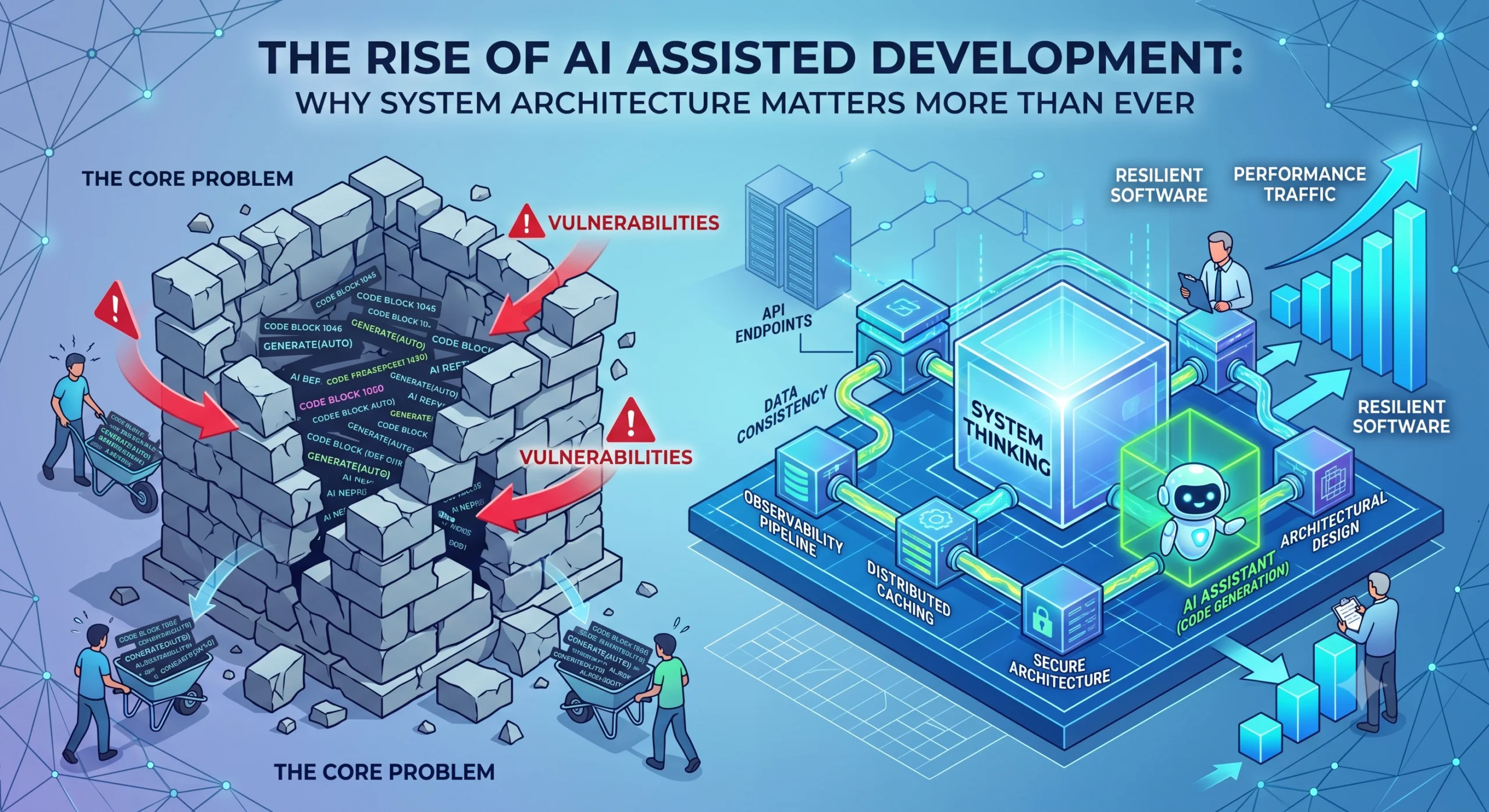
The way we write software is changing faster than at any point since the adoption of high-level languages. Generative AI tools are exceptionally proficient at streamlining repetitive tasks, explaining complex logic blocks, and suggesting quick refactors. But speed does not equal quality, and this shift introduces a critical engineering dilemma. The Core Problem The adoption of AI coding assistants fundamentally changes the developer’s workflow. If junior developers blindly accept AI generated output without a fundamental understanding of how software operates beneath the syntax layer, they risk introducing massive vulnerabilities and structural flaws. The visual metaphor is stark: you may be able to generate code “bricks” faster than ever, but if they are poorly stacked, you are simply building a structure that is guaranteed to collapse. The Engineering Reality For decades, developers were evaluated primarily on their ability to memorize syntax and write raw code. That definition is now obsolete. In modern engineering, the role of a developer overlaps heavily with architecture, security protocol enforcement, and system performance tuning. Modern backend engineering requires a deep understanding of concepts that AI cannot fully grasp in isolation. An engineer must comprehend: Distributed systems and their trade-offs. API versioning strategies. Data consistency across caches and databases. Robust observability pipelines. If a developer does not understand these architectural principles, the system will fail spectacularly when subjected to production traffic. The Architectural Fix To build resilient software in an era of AI assistance, engineering teams must refocus on system fundamentals. Training should prioritize problem solving and system thinking over learning the newest trending framework. Employers and technical leads are increasingly prioritizing practical skills and architectural awareness. Developers who succeed in this landscape master one domain deeply, understand the intricacies of scaling monolithic versus microservice architectures, and build systems with a defensive programming mindset from day one. The tools may generate the code, but the human engineer must still design the system responsibly. The era of the pure “syntax memorizer” is over; the era of the “system architect” is now mandatory.

How Agentic AI Makes a Difference in System Integrations and Transformations
System integration is where most digital transformation budgets quietly disappear. The glamorous part is the new platform, the redesigned UI, the fresh data model. The unglamorous part is connecting that shiny new thing to the five legacy systems it has to talk to, handling the edge cases, and keeping it all running when third-party APIs change without notice. We have spent years on integration projects at Helixz Solutions, and agentic AI is the first technology that genuinely changes the economics of this work. Not by replacing the engineer, but by taking on the repetitive grunt work that eats most of an integration budget. The Traditional Integration Problem Before we get to what changes, it helps to be honest about the problem. Here is what integration work actually involves on a typical project. Mapping fields System A calls it customer_id. System B calls it acct_no. System C calls it clientRef. Someone has to sit down, open both schemas, and build a mapping document. This is tedious, error-prone work that depends on domain knowledge and patience in equal measure. Handling edge cases The happy path takes a day to build. The edge cases take a week. What happens when a date comes in as a string instead of a timestamp? When a nullable field is suddenly required? When a currency code is lowercase? When an address field contains a whole JSON blob someone stuffed in there three years ago? Every integration is a long tail of “what if” handling. Debugging sync failures A sync breaks at 3am. The logs are cryptic. Was it authentication? A rate limit? A changed field? A timeout? Someone has to dig through logs, reproduce the issue, and patch it. Then it breaks again next week for a different reason. Documentation that is always outdated You write integration docs on day one. By day thirty the API has changed twice, the mapping has been patched four times, and the docs describe a system that no longer exists. Everyone knows the docs are wrong. No one has time to fix them. New team members onboard slowly because the source of truth lives in the head of the one engineer who built it. If any of this sounds familiar, you have done integration work. Now let us look at where agentic AI changes the picture. How AI Agents Help With Integration Work Agentic AI is not magic, but it is genuinely useful for specific, well-scoped parts of integration work. Here is where we have seen it deliver. Auto-discovering API schemas When you point an agent at an API, it can probe the endpoints, read the responses, infer the schema, and produce a structured description of what the API offers. This is faster than reading incomplete docs, and it captures what the API actually does today, not what it did when someone last updated the wiki. Generating integration code Given a source schema and a target schema, an agent can draft the mapping code, including type conversions, null handling, and validation. A human reviews and adjusts, but the first draft, which used to take hours, now takes minutes. The agent also tends to handle the boring edge cases (date formats, currency rounding, empty arrays) more thoroughly than a tired engineer. Detecting data anomalies An agent monitoring a sync pipeline can spot when records look wrong before they cause downstream problems. A field that was always numeric now contains text. A record count that was steady suddenly drops by half. A field that was optional is now present on every record. These are signals that something upstream changed, and catching them early saves hours of debugging later. Self-healing broken syncs This is the one that gets the most attention, so let us be precise about what it means. “Self-healing” does not mean the agent magically fixes everything. It means the agent can: Detect that a sync failed. Read the error and the recent data to understand why. Attempt a fix: retry with adjusted parameters, remap a changed field, fall back to a secondary endpoint. If it cannot fix it, escalate to a human with a clear summary of what happened and what it tried. This is useful because most sync failures are mundane: an expired token, a renamed field, a transient timeout. An agent that handles the mundane ones and escalates only the real problems saves significant on-call time. Generating documentation An agent that lives inside your integration pipeline can keep documentation current by design. Every time a mapping changes, every time a new endpoint is added, the agent regenerates the relevant docs from the actual running code. The docs describe the system as it is, not as it was. This alone justifies the effort for teams that have given up on keeping integration docs accurate. Real Scenarios Where This Matters Let us make this concrete with scenarios we have actually hit on client projects. When a third-party API changes without notice A payment provider updates their API on a Tuesday. They send an email that no one reads. Wednesday morning, your checkout sync starts failing. Without an agent, an engineer gets paged, digs through logs, finds the changed field, updates the mapping, tests, and deploys. Best case: two to four hours of downtime and lost engineer time. With an agent monitoring the sync, it detects the field change, identifies the likely cause from the error pattern, drafts a revised mapping, and alerts the engineer with a suggested fix. The engineer reviews, approves, and deploys in twenty minutes. The agent did not fix it alone, but it compressed the time to resolution by handling the investigation. When data formats shift A client’s ERP starts sending dates in ISO 8601 instead of the legacy format they used for years. The integration code expects the old format and starts rejecting records. An anomaly-detecting agent spots the format change in the first batch, flags it, and drafts a conversion fix. The data team finds out from the agent’s alert, not from a downstream report

Java & AI : From Enterprise Workhorse to Intelligent Powerhouse
Mastering the Flow: Event-Driven Architecture Essentials Key Insights from Our Internal Engineering Training As modern systems scale, traditional tightly coupled architectures often struggle to keep up. To tackle these challenges, we recently held an internal Event-Driven Architecture (EDA) training session for our engineering team. The session sparked deep discussions on building scalable, resilient, and agile systems that can handle real-world demands. In this blog, we’re sharing an expanded version of the concepts and practical lessons learned during the session—perfect for any team looking to adopt or refine their EDA strategy.

Digital Transformation With Agentic AI: What Changes and What Stays the Same
Digital Transformation With Agentic AI: What Changes and What Stays the Same Every few years a new technology lands and the conversation around digital transformation resets. Cloud did it. Mobile did it. Generative AI did it. Now agentic AI is doing it, and the same questions come up at every client meeting we sit in on: Is this actually different? Do we have to rebuild what we just built? What stays the same? We have spent the last two years building AI-driven platforms for Sri Lankan and international clients, and we want to give you a grounded answer. Not hype, not a pitch. A practical view of what agentic AI changes about digital transformation, what it leaves untouched, and where it makes sense to start. What Agentic AI Actually Is Agentic AI refers to AI systems that can plan, decide, and execute tasks with minimal human intervention. The key word is “execute.” A large language model can write you a draft. An agentic system can read a request, break it into steps, call the right tools or APIs, decide what to do with the results, and finish the task. Think of the difference between a calculator and a junior accountant. The calculator does exactly what you tell it. The accountant understands the goal, figures out which calculations matter, asks questions when something is unclear, and produces a reconciled report. Agentic AI sits closer to the accountant than the calculator, though it is far from replacing either. The components that make a system “agentic”: Planning: The model decomposes a goal into ordered steps. Tool use: It can call functions, query databases, hit APIs, or run code. Memory: It retains context across steps and sometimes across sessions. Decision making: It picks between options based on the results of previous steps. Action: It produces a real change in a system, not just text output. Not every product that calls itself an “agent” has all five. Many are single-step prompt wrappers with a fancy UI. The distinction matters when you are evaluating vendors. How Agentic AI Differs From Traditional Automation and Generative AI Three categories get mixed up constantly. Here is how we separate them in practice. Traditional automation (RPA, scripts, cron jobs) These follow explicit, hard-coded rules. “If field X is empty, copy value from field Y.” They are deterministic, fast, and brittle. When the source system changes a field name, the script breaks and someone gets paged at 2am. Traditional automation is good for stable, repetitive work where the rules rarely change. Generative AI (ChatGPT-style) This produces content: text, images, code. It responds to a prompt with an output but does not act on its own. You ask, it answers. It cannot decide to go check a second system because the first one looked off. Generative AI is powerful for drafting, summarising, and transforming content, but it is reactive by design. Agentic AI This combines the flexibility of generative models with the ability to take action. An agentic system can receive a goal like “reconcile today’s invoice batch against the ledger,” plan the steps, fetch data from two systems, flag mismatches, draft correcting entries, and ask a human to approve before posting. The human is still in the loop, but the grunt work is gone. The simplest way we explain it to clients: generative AI gives you an answer, agentic AI gets the job done. Where Agentic AI Fits in a Digital Transformation Journey Digital transformation is not a single project. It is a sequence of stages, and agentic AI fits into different points depending on where you are. Digitisation: Moving from paper to digital records. Agentic AI has little role here. You need clean data entry and stable storage first. Digitalisation: Connecting systems and automating workflows. This is where traditional automation and integration work live. Agentic AI can start to help with discovery and anomaly detection. Transformation: Rethinking how the business operates. This is where agentic AI earns its place, because the workflows are now fluid enough to support autonomous steps. A mistake we see often: companies try to bolt agentic AI onto stage one. They have messy spreadsheets and disconnected systems, and they hope an agent will paper over the chaos. It will not. Agents amplify whatever state your data and processes are in. If that state is messy, you get fast, confident mess. Practical Use Cases for Agentic AI Let us get specific. These are use cases we have built or evaluated for clients. Automated data reconciliation Finance teams spend hours matching records between systems: bank statements against the ledger, sales orders against fulfilment data, vendor invoices against purchase orders. An agentic system can pull from both sources, apply matching rules, handle fuzzy matches on names and amounts, flag exceptions, and produce a reconciliation report with suggested adjustments. A human reviews the exceptions, not the whole batch. Intelligent document processing Traditional OCR pulls text from a scanned invoice. It does not know which number is the tax amount and which is the line total. An agentic pipeline can read the document, understand its structure, cross-reference against a vendor master record, validate totals, and route the invoice for approval, all without a person touching the document unless something looks wrong. Autonomous monitoring and alerting Instead of static thresholds (“alert if CPU > 90%”), an agentic monitor can look at patterns across metrics, correlate with recent deployments or external events, decide whether an alert is real or noise, and draft an initial incident summary. This reduces alert fatigue and shortens time to triage. AI-assisted decision making This is the one that needs the most care. An agent can pull sales data, market signals, and historical patterns, then present a ranked set of options with tradeoffs. It does not make the final call on a strategic decision. It compresses the research so a human can decide faster. What Does NOT Change This is the section most vendor decks skip. Here is what stays the same whether you adopt agentic AI or


