

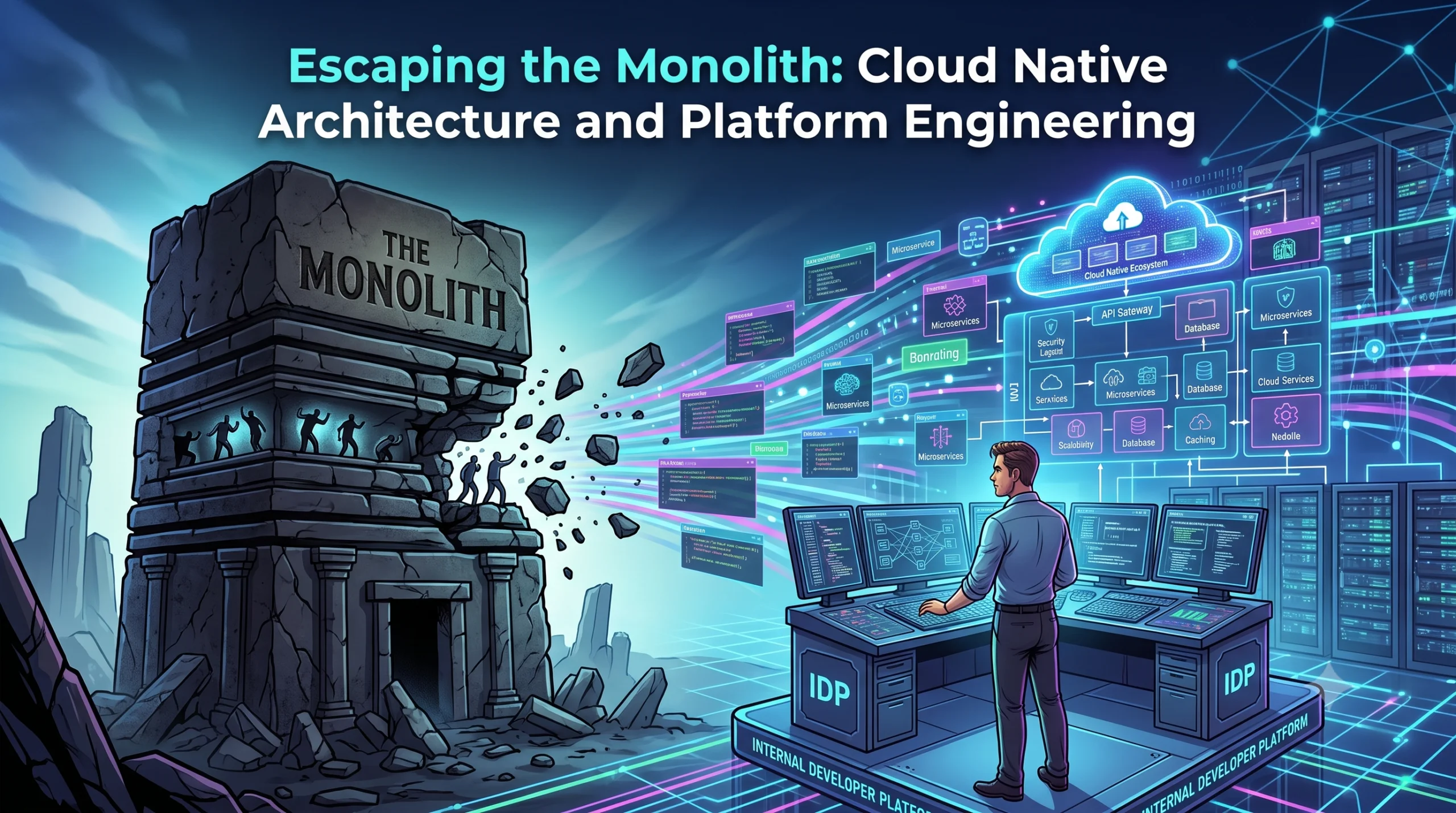
The overarching narrative is one of liberation. “Escaping the Monolith” sets the stage for a classic problem in software development. “Cloud Native Architecture and Platform Engineering” are the tools and methods used for that escape, leading to a state of improved efficiency, speed, and scalability.
Part 1: The Challenge – The Monolithic System
What is a Monolith?
A monolithic architecture is a traditional model for software development. The entire application is built as a single, indivisible unit. All components—the user interface, business logic, data access layer, and integrations—are tightly coupled and deployed together as one piece of software. It often shares a single database.
Why Do Organizations “Escape” It? (The Pain Points)
While monoliths have advantages for small projects (simplicity, single point of deployment), they become a significant hindrance as the application and team grow. Organizations decide to “escape” for several critical reasons:
- Slow and Rigid Deployment Cycles: Changing even one small piece of code requires rebuilding, retesting, and redeploying the entire application. This leads to “big bang” deployments, which are rare, high-risk, and slow innovation.
- Scalability Issues: You must scale the entire application, even if only one specific module is under load. This is inefficient and costly.
- Tight Coupling and Dependency Hell: Over time, components become hopelessly intertwined. Changing a feature in one part of the code can cause unexpected breakages in distant, seemingly unrelated areas. Testing becomes a nightmare.
- Technology Lock-in: The entire monolith is typically built with a single technology stack (e.g., all Java, all .NET). This makes it difficult to adopt new, better languages or frameworks for specific functionalities.
- Difficulty for New Developers: For large systems, the codebase becomes so massive and complex that new developers face a steep learning curve before they can make productive contributions.
Part 2: The Goal – Cloud Native Architecture
“Cloud Native Architecture” is the target state—the new paradigm that promises to solve the problems of the monolith. It is an approach to building and running applications that exploits the advantages of the cloud computing model.
Key Pillars of Cloud Native
Cloud native is not just about where you run your app (in the cloud), but how you design it. The Cloud Native Computing Foundation (CNCF) outlines several core pillars:
- Microservices: This is the direct architectural alternative to the monolith. You break down the large, single application into small, independent, and loosely coupled services. Each service is built around a specific business capability, has its own data store (ideally), and communicates via well-defined APIs. This enables independent development, scaling, and deployment.
- Containers: Microservices are often packaged and run inside containers (like Docker). Containers isolate the application and its dependencies into a single package that can run reliably across any environment (dev, test, production).
- Container Orchestration (e.g., Kubernetes): Managing hundreds or thousands of containers is impossible manually. Container orchestration platforms like Kubernetes automate the deployment, scaling, and management of containerized applications.
- Continuous Delivery (CI/CD): A high degree of automation is required. Code changes should be automatically tested, built, and frequently deployed to production with minimal risk.
- Dynamic Infrastructure and DevOps: The architecture should utilize APIs provided by the cloud provider to dynamically manage resources (like databases and compute). This is enabled by a DevOps culture of collaboration and automation.
Benefits of the Cloud Native State
Moving to a cloud-native architecture offers several game-changing benefits:
- Agility and Speed to Market: Teams can deploy updates for their specific microservice independently, allowing for faster experimentation and innovation.
- Scalability: Each microservice can be scaled independently based on its own traffic patterns, optimizing resource usage.
- Resilience and Fault Tolerance: If one microservice fails, it doesn’t bring down the entire application. The system can self-heal.
- Improved Developer Productivity: Developers work on smaller, more understandable codebases, and the “dependency hell” is largely eliminated.
Part 3: The Enabler – Platform Engineering
This is the newest and perhaps most critical element in the sequence. While cloud-native offers great promise, the reality of managing microservices, Kubernetes, and intricate cloud infrastructure introduces immense operational complexity.
“Escaping the Monolith” and adopting “Cloud Native” without a proper enabling layer often leads to a new problem: “Kubernetes Hell” or “Ops Burnout.” Every developer is forced to become an infrastructure expert, spend hours setting up CI/CD pipelines, and manage security, which distracts them from writing business value code.
This is where Platform Engineering comes in.
What is Platform Engineering?
Platform Engineering is the discipline of building and operating Internal Developer Platforms (IDPs).
An Internal Developer Platform is a self-service layer that abstracts away the underlying infrastructure and operational complexity, providing developers with everything they need to build, deploy, and run applications quickly and securely.
Core Functions of a Platform Engineering Team:
- Build “Golden Paths”: The platform team creates pre-approved, automated, and secure configurations for common tasks (e.g., “spinning up a new microservice,” “deploying to production,” “creating a PostgreSQL database”). This creates a “paved road” for 90% of development needs, promoting best practices.
- Enable Self-Service: Developers should not have to file tickets for routine infrastructure requests. The IDP provides a self-service interface (CLI or UI) to perform these tasks.
- Abstract Infrastructure Complexity: Developers do not need to be experts in Kubernetes manifests or Terraform. The IDP translates simple requests into complex infrastructure-as-code actions.
- Provide Governance and Compliance: The platform team bakes security, compliance, and budget guardrails directly into the infrastructure and workflows, ensuring everything is built securely by default.
- Focus on “Developer Experience” (DevEx): The ultimate goal is to make the application development process as smooth and frictionless as possible. The platform should “delight” the developers, not be an obstacle.
The Relationship: Platform Engineering as a Catalyst
- Platform Engineering makes Cloud Native possible at scale. It solves the human and operational challenges of a microservices and container-based architecture.
- By enabling a true DevOps culture (developers can “own” their service because the platform makes the operational parts easy), Platform Engineering becomes the essential bridge that makes “Escaping the Monolith” successful and sustainable.
Conclusion: The New Way of Working
The journey described by your title is the standard evolution for large-scale application development:
- We start with the constraints of a Monolith.
- We seek the freedom and capability of Cloud Native Architecture.
- We find the complexity unmanageable.
- We build Platform Engineering teams and Internal Developer Platforms to abstract that complexity and empower our developers.
This allows organizations to finally achieve the core promise of cloud native: innovation at the speed of business.


