

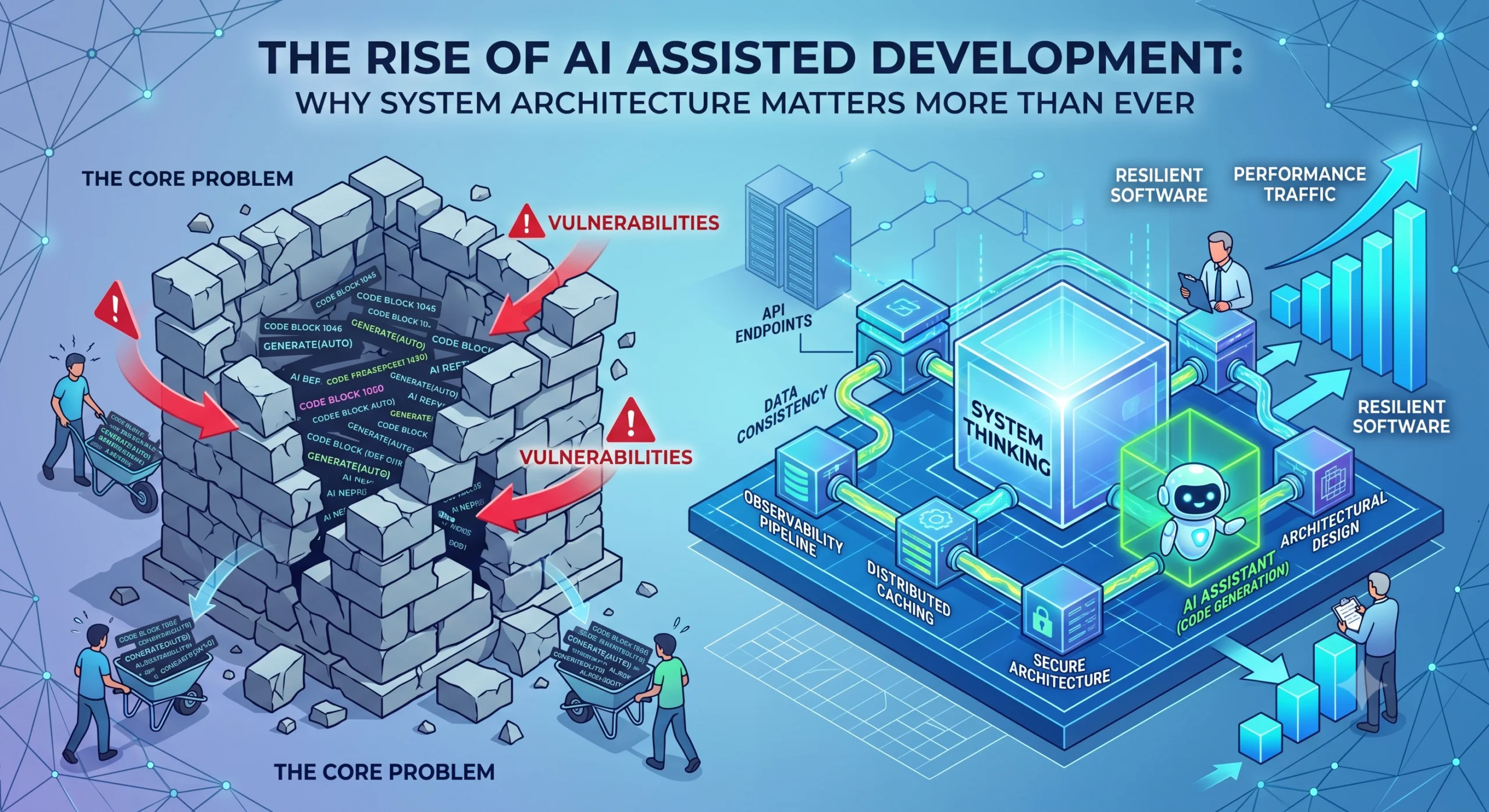
The way we write software is changing faster than at any point since the adoption of high-level languages. Generative AI tools are exceptionally proficient at streamlining repetitive tasks, explaining complex logic blocks, and suggesting quick refactors. But speed does not equal quality, and this shift introduces a critical engineering dilemma. The Core Problem The adoption of AI coding assistants fundamentally changes the developer’s workflow. If junior developers blindly accept AI generated output without a fundamental understanding of how software operates beneath the syntax layer, they risk introducing massive vulnerabilities and structural flaws. The visual metaphor is stark: you may be able to generate code “bricks” faster than ever, but if they are poorly stacked, you are simply building a structure that is guaranteed to collapse. The Engineering Reality For decades, developers were evaluated primarily on their ability to memorize syntax and write raw code. That definition is now obsolete. In modern engineering, the role of a developer overlaps heavily with architecture, security protocol enforcement, and system performance tuning. Modern backend engineering requires a deep understanding of concepts that AI cannot fully grasp in isolation. An engineer must comprehend: Distributed systems and their trade-offs. API versioning strategies. Data consistency across caches and databases. Robust observability pipelines. If a developer does not understand these architectural principles, the system will fail spectacularly when subjected to production traffic. The Architectural Fix To build resilient software in an era of AI assistance, engineering teams must refocus on system fundamentals. Training should prioritize problem solving and system thinking over learning the newest trending framework. Employers and technical leads are increasingly prioritizing practical skills and architectural awareness. Developers who succeed in this landscape master one domain deeply, understand the intricacies of scaling monolithic versus microservice architectures, and build systems with a defensive programming mindset from day one. The tools may generate the code, but the human engineer must still design the system responsibly. The era of the pure “syntax memorizer” is over; the era of the “system architect” is now mandatory.


