

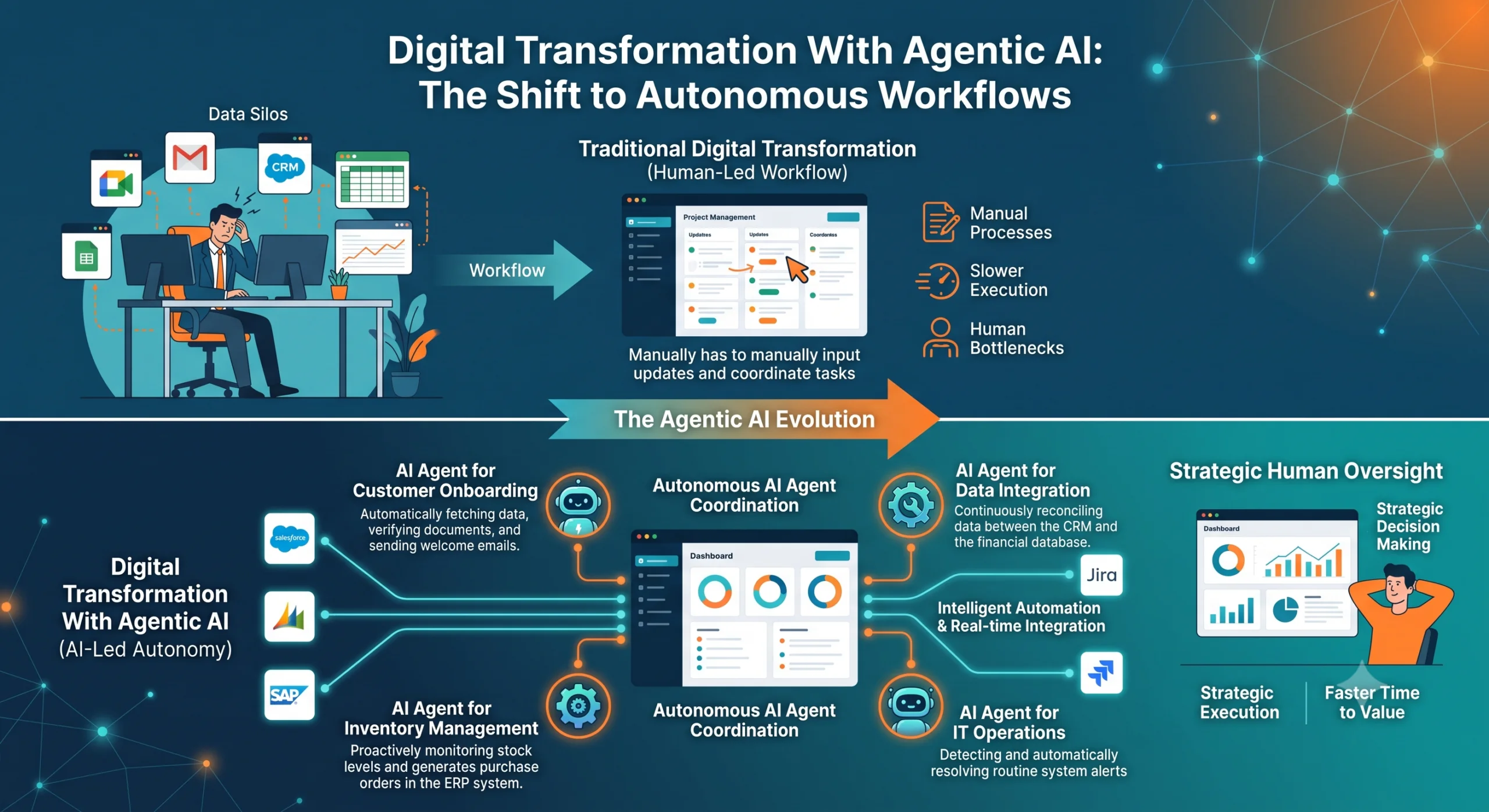
Digital Transformation With Agentic AI: What Changes and What Stays the Same Every few years a new technology lands and the conversation around digital transformation resets. Cloud did it. Mobile did it. Generative AI did it. Now agentic AI is doing it, and the same questions come up at every client meeting we sit in on: Is this actually different? Do we have to rebuild what we just built? What stays the same? We have spent the last two years building AI-driven platforms for Sri Lankan and international clients, and we want to give you a grounded answer. Not hype, not a pitch. A practical view of what agentic AI changes about digital transformation, what it leaves untouched, and where it makes sense to start. What Agentic AI Actually Is Agentic AI refers to AI systems that can plan, decide, and execute tasks with minimal human intervention. The key word is “execute.” A large language model can write you a draft. An agentic system can read a request, break it into steps, call the right tools or APIs, decide what to do with the results, and finish the task. Think of the difference between a calculator and a junior accountant. The calculator does exactly what you tell it. The accountant understands the goal, figures out which calculations matter, asks questions when something is unclear, and produces a reconciled report. Agentic AI sits closer to the accountant than the calculator, though it is far from replacing either. The components that make a system “agentic”: Planning: The model decomposes a goal into ordered steps. Tool use: It can call functions, query databases, hit APIs, or run code. Memory: It retains context across steps and sometimes across sessions. Decision making: It picks between options based on the results of previous steps. Action: It produces a real change in a system, not just text output. Not every product that calls itself an “agent” has all five. Many are single-step prompt wrappers with a fancy UI. The distinction matters when you are evaluating vendors. How Agentic AI Differs From Traditional Automation and Generative AI Three categories get mixed up constantly. Here is how we separate them in practice. Traditional automation (RPA, scripts, cron jobs) These follow explicit, hard-coded rules. “If field X is empty, copy value from field Y.” They are deterministic, fast, and brittle. When the source system changes a field name, the script breaks and someone gets paged at 2am. Traditional automation is good for stable, repetitive work where the rules rarely change. Generative AI (ChatGPT-style) This produces content: text, images, code. It responds to a prompt with an output but does not act on its own. You ask, it answers. It cannot decide to go check a second system because the first one looked off. Generative AI is powerful for drafting, summarising, and transforming content, but it is reactive by design. Agentic AI This combines the flexibility of generative models with the ability to take action. An agentic system can receive a goal like “reconcile today’s invoice batch against the ledger,” plan the steps, fetch data from two systems, flag mismatches, draft correcting entries, and ask a human to approve before posting. The human is still in the loop, but the grunt work is gone. The simplest way we explain it to clients: generative AI gives you an answer, agentic AI gets the job done. Where Agentic AI Fits in a Digital Transformation Journey Digital transformation is not a single project. It is a sequence of stages, and agentic AI fits into different points depending on where you are. Digitisation: Moving from paper to digital records. Agentic AI has little role here. You need clean data entry and stable storage first. Digitalisation: Connecting systems and automating workflows. This is where traditional automation and integration work live. Agentic AI can start to help with discovery and anomaly detection. Transformation: Rethinking how the business operates. This is where agentic AI earns its place, because the workflows are now fluid enough to support autonomous steps. A mistake we see often: companies try to bolt agentic AI onto stage one. They have messy spreadsheets and disconnected systems, and they hope an agent will paper over the chaos. It will not. Agents amplify whatever state your data and processes are in. If that state is messy, you get fast, confident mess. Practical Use Cases for Agentic AI Let us get specific. These are use cases we have built or evaluated for clients. Automated data reconciliation Finance teams spend hours matching records between systems: bank statements against the ledger, sales orders against fulfilment data, vendor invoices against purchase orders. An agentic system can pull from both sources, apply matching rules, handle fuzzy matches on names and amounts, flag exceptions, and produce a reconciliation report with suggested adjustments. A human reviews the exceptions, not the whole batch. Intelligent document processing Traditional OCR pulls text from a scanned invoice. It does not know which number is the tax amount and which is the line total. An agentic pipeline can read the document, understand its structure, cross-reference against a vendor master record, validate totals, and route the invoice for approval, all without a person touching the document unless something looks wrong. Autonomous monitoring and alerting Instead of static thresholds (“alert if CPU > 90%”), an agentic monitor can look at patterns across metrics, correlate with recent deployments or external events, decide whether an alert is real or noise, and draft an initial incident summary. This reduces alert fatigue and shortens time to triage. AI-assisted decision making This is the one that needs the most care. An agent can pull sales data, market signals, and historical patterns, then present a ranked set of options with tradeoffs. It does not make the final call on a strategic decision. It compresses the research so a human can decide faster. What Does NOT Change This is the section most vendor decks skip. Here is what stays the same whether you adopt agentic AI or


