

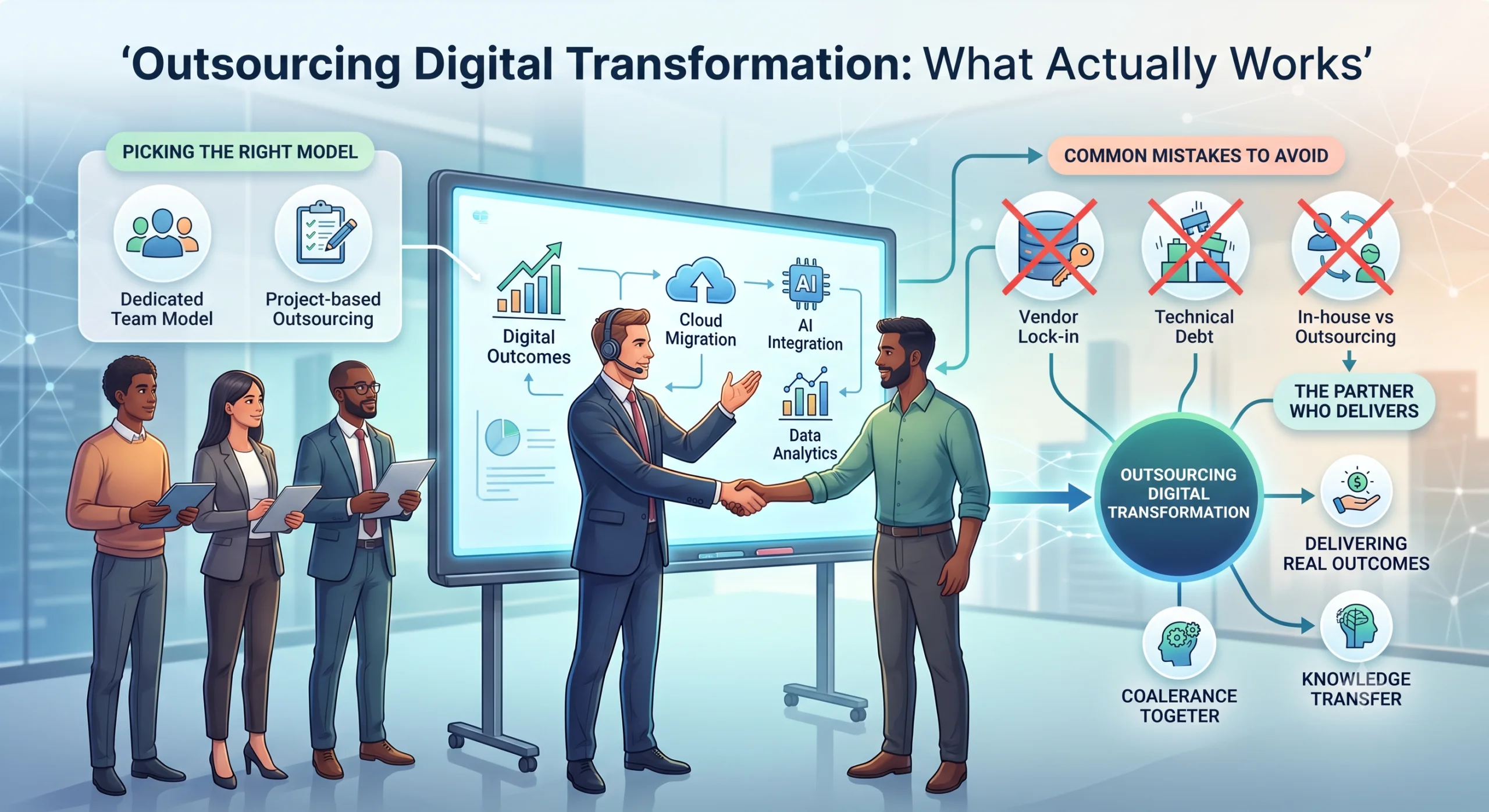
Companies outsource digital transformation for good reasons. They lack in-house engineering capacity. They need to move faster than hiring allows. They want to control costs instead of building a permanent team. These are valid motivations. The problem is that most outsourcing efforts fail before the first line of code gets written.
We have seen it from both sides. As a Sri Lankan software company founded in 2023 by three engineers, Helixz Solutions takes on outsourced transformation work regularly. Some clients arrive with clear goals and strong internal ownership. Others arrive with a budget and a vague wish. The difference in outcomes is stark.
This post covers what actually works when you outsource digital transformation, the mistakes that sink projects, and how to pick a partner worth trusting with your systems.
Why Companies Outsource Digital Transformation
The reasons usually fall into three categories.
Lack of in-house expertise. Most companies do not employ specialists in cloud migration, API integration, mobile development, and data engineering all at once. Building that team through hiring takes six to twelve months. Outsourcing gives you access to people who have done this work before, across multiple industries.
Speed. A dedicated external team can start within weeks. You skip recruiting, onboarding, and ramp-up time. For a company facing competitive pressure or an aging system nearing failure, that speed matters more than perfect cost optimization.
Cost. Outsourcing to a market like Sri Lanka, where engineering talent is strong but rates are lower than North America or Western Europe, reduces spend without cutting quality. The math works when the work is well-defined. It falls apart when cost becomes the only factor in the decision.
The companies that succeed treat outsourcing as a capability decision, not a procurement decision. They ask what skills they need, how fast they need them, and what outcomes they expect. Then they find a partner who can deliver.
The Common Mistakes That Sink Outsourced Transformations
Most failures share the same root causes. Here are the ones we see repeatedly.
Treating It as a Pure Cost Play
When the primary goal is spending less money, everything else suffers. The cheapest vendor wins the contract. Requirements get trimmed to fit the budget. Quality drops. The project either ships late, ships broken, or never ships at all. You save money on paper and lose far more in rework, delays, and lost business.
Cost matters. It should never be the deciding factor above competence and fit.
Not Defining Outcomes
“We want to digitally transform” is not an outcome. “Reduce order processing time from three days to four hours by replacing the manual workflow with an automated system” is an outcome. Vendors cannot deliver what you cannot define. When the goal is vague, the vendor guesses, and the result rarely matches what leadership had in mind.
Write down the specific business outcomes before you talk to a single vendor. Measure success against them.
No Internal Ownership
This is the most damaging mistake. A company hands the entire transformation to an external team and walks away. No internal product owner. No technical counterpart. No one accountable for decisions, priorities, or alignment with business goals.
Outsourcing shifts execution, not accountability. You still need someone inside your company who owns the outcome, makes tradeoff decisions, and keeps the project connected to real business needs. Without that person, the vendor works in a vacuum and you get software nobody uses.
Picking the Cheapest Vendor
The cheapest bid almost always costs the most in the end. Low bids assume optimistic timelines, minimal scope, and junior engineers doing senior work. Change requests pile up. Deadlines slip. You either pay more to fix the problems or start over with a different vendor.
Evaluate vendors on technical depth, relevant experience, and communication first. Consider cost after you have a shortlist of qualified partners.
Outsourcing Models: Project-Based, Dedicated Team, Hybrid
The model you choose shapes how the work gets done. There is no universal best option. There is the right option for your situation.
Project-Based
You define the scope, timeline, and deliverables upfront. The vendor commits to a fixed price and hands over the finished work.
This model works well for well-defined projects with stable requirements. A marketing website rebuild. A point integration between two systems. A mobile app with a clear feature list.
It fails when requirements are uncertain or likely to change. Digital transformation projects usually involve discovery and unexpected complexity. Every change becomes a negotiation, and the relationship turns adversarial.
Dedicated Team
You hire a team from the vendor that works exclusively on your projects. You manage priorities and direction. The vendor handles team composition, retention, and infrastructure.
This model fits ongoing transformation work where priorities shift and the scope is large. You get continuity, deep knowledge of your systems, and flexibility to redirect the team. The cost is higher commitment, usually a minimum engagement period, and the need for strong internal product management.
Hybrid
A core dedicated team handles the main work, supplemented by project-based resources for specific, bounded tasks. A dedicated team builds the platform. A project-based team delivers a one-off migration or a specialized integration.
This is the most common arrangement we see. It balances flexibility with cost control. The dedicated team carries institutional knowledge. The project-based resources handle work that requires specialized skills.
How to Evaluate an Outsourcing Partner
Choosing a partner is the single most important decision in an outsourced transformation. Here is what to evaluate, in order of importance.
Technical Depth
Ask for specifics. What systems have they integrated? What cloud platforms do they work with daily? Can they show you architecture they designed, not just code they wrote? A vendor that talks in generalities about “digital solutions” without concrete examples is a red flag.
We are always ready to walk through past integration work in detail. A partner who cannot or will not is hiding a lack of real experience.
Integration Experience
Most transformation work is integration work. Connecting a new app to an existing ERP. Syncing data between a legacy database and a modern platform. Building APIs that bridge old and new systems. Pure greenfield development is rare.
Ask the vendor how they approach integrations with systems they have never seen before. Listen for talk of discovery, documentation, and incremental testing. Beware of vendors who claim they can integrate anything in a week.
Communication
You will work with this team for months or years. Communication quality predicts project health better than any technical credential. Do they ask clarifying questions? Do they push back when requirements are unclear?
Poor communication surfaces as missed requirements, surprise delays, and software that does not match expectations. Pay attention to how a vendor communicates during the sales process.
Cultural Fit
This is not about shared hobbies. It is about working style. Do their hours overlap with yours? How do they handle disagreements? Do they document decisions or rely on conversation alone? A partner whose working style clashes with yours will create friction on every decision.
The Hidden Costs of Outsourcing Gone Wrong
When outsourcing fails, the costs extend far beyond the invoice.
Technical Debt
A vendor under time pressure ships code that works today but creates problems tomorrow. No tests. No documentation. Hardcoded values. Workarounds left in place. The next team that touches the code spends weeks understanding it before they can add anything new.
Knowledge Transfer Gaps
When the vendor leaves, who understands the system? If the answer is “nobody on our side,” you have a problem. The system runs, but nobody can maintain it, extend it, or fix it when it breaks. You are dependent on the vendor for every change, or you pay for a new team to learn it from scratch.
Vendor Lock-In
Some vendors build systems that only they can maintain. Proprietary frameworks. Undocumented configurations. Custom abstractions over standard tools. You cannot switch vendors without a full rewrite. This turns a partnership into a trap.
Best Practices for Outsourced Transformation
These practices come from projects that worked. Follow them.
Keep a strong internal product owner. One person inside your company owns the outcome. They make priority calls, approve milestones, and keep the project aligned with business goals. This is not a part-time role. If nobody owns it internally, nobody will own the result.
Require documentation from day one. Architecture decisions. API contracts. Data models. Setup and deployment steps. Require it as a deliverable, not an afterthought. Documentation is what lets you switch vendors, onboard new staff, and maintain the system long after the original team moves on.
Set clear milestones. Break the work into checkpoints that produce something testable. Do not wait six months to see working software. Monthly or biweekly milestones force early detection of problems and keep everyone honest about progress.
Choose partners with real integration experience. Ask for specific examples. Talk to references. Confirm the vendor has connected systems they had not seen before. Integration experience, not general development experience, is what transformation work demands.
Define what done means. Before the project starts, write down the acceptance criteria. What does the system need to do? What does it need to integrate with? How do you measure success? A shared definition of done prevents the most common end-of-project disputes.
How Helixz Solutions Approaches Outsourced Transformation
Helixz Solutions was founded in 2023 by three engineers who wanted to build software the right way. We are based in Sri Lanka, and we work with companies that need custom integrations, applications, and digital transformation support.
Our approach reflects what we have learned matters most.
We start with discovery. Before we write code, we understand your current systems, your data, and the constraints you are working within. We ask what success looks like and how you will measure it.
We assign a dedicated team that stays with your project. You get continuity and a team that learns your systems over time.
We document everything we build. Architecture, APIs, data flows, deployment steps. This protects you if you ever work with another vendor, and it protects us from knowledge loss as teams grow.
We ship in short cycles. You see working software regularly, not a big reveal months down the line. Early feedback prevents expensive course corrections later.
We focus on integration work. Most of our projects involve connecting new software to existing systems. We are comfortable working with legacy platforms, undocumented APIs, and messy data.
When to Outsource vs Build In-House
This question comes up in every conversation. The answer depends on your situation.
Outsource when:
- You need specialized skills you will not use full-time after the project
- Your timeline is too tight to hire and ramp up a team
- The work is bounded and well-defined enough to hand off
- You want to move fast without committing to permanent headcount
Build in-house when:
- The system is core to your business and you need to own it long-term
- You will need ongoing iteration that requires deep, permanent knowledge
- You have the budget and time to hire the right people
- The work involves proprietary processes you cannot share externally
Most companies do both. They outsource the build and migration work, then bring maintenance in-house as the system stabilizes. Or they keep a small internal team that owns direction and partners with an external team for execution. The hybrid approach produces the best balance of speed, cost, and long-term sustainability.
Examples: Two Outsourcing Scenarios
Scenario 1: The Cost-Driven Project That Failed
A retail company needed to modernize its inventory system. They chose the cheapest vendor from five bids. The vendor quoted three months and a low fixed price. Six months in, the project was half done. Requirements had drifted. The vendor refused to continue without a new contract at double the original price. The company walked away with unusable code and started over. The total cost was nearly three times the original bid, plus a year of lost time.
The lesson: the cheapest bid is rarely the cheapest outcome.
Scenario 2: The Outcome-Driven Project That Worked
A logistics company needed to replace a manual shipment tracking process with an automated system. They defined the outcome: reduce manual entry by 80 percent and cut tracking errors by half. They assigned an internal product owner who worked with the vendor weekly. The vendor delivered in four months across biweekly milestones. The system integrated with the existing ERP. Six months after launch, the internal team maintained it with occasional vendor support.
The lesson: clear outcomes, internal ownership, and a competent partner produce results.
FAQ
How much does outsourcing digital transformation cost?
It varies based on scope, complexity, and the model you choose. A focused project might run a few thousand dollars a month with a dedicated team. The useful comparison is not vendor rate versus vendor rate. It is total cost including internal time, rework risk, and the cost of getting it wrong.
How do I avoid vendor lock-in?
Require open standards and documented interfaces. Avoid proprietary frameworks the vendor controls exclusively. Demand documentation as a deliverable. Make sure someone on your team understands the system well enough to work with another vendor if needed.
What is the biggest risk in outsourcing digital transformation?
Lack of internal ownership. A vendor can build good software, but if nobody inside your company owns the outcome, the project drifts. Priorities get misaligned. The result does not match business needs. Internal ownership is the single most important success factor.
Should I choose a fixed-price or dedicated team model?
For well-defined projects with stable requirements, fixed-price works. For transformation work where requirements evolve, a dedicated team is usually the better fit. Fixed-price contracts create pressure to freeze scope early, which fights the reality that transformation involves discovery and change.
How long does an outsourced digital transformation take?
A focused project can take two to four months. A multi-system transformation can take six to eighteen months. Anyone promising a precise timeline before discovery is guessing. Ask for a phased estimate with milestones.
Conclusion
Outsourcing digital transformation works when you treat it as a partnership built on clear outcomes, internal ownership, and a competent technical partner. It fails when cost is the only criterion and outcomes stay undefined.
The companies that get this right define what success looks like before they start. They keep a strong internal owner. They pick a partner with real integration experience, not just a low rate. They require documentation, set milestones, and stay involved throughout.
At Helixz Solutions, we have built our process around these principles. We start with discovery. We assign dedicated teams. We document what we build. We ship in short cycles. If you are considering an outsourced transformation and want a partner who will work with you rather than just for you, that is where the conversation starts.


