

Digital transformation is one of those terms that gets thrown around so much it starts to mean nothing. Vendors use it to sell software. Consultants use it to sell services. Companies use it to describe anything they do with a computer.
This guide cuts through that. We have built digital transformation projects for companies in Sri Lanka, including a major import-export company whose legacy system we replaced and integrated with their bookkeeping and HR systems. That work taught us what transformation actually involves, and what it does not.
What Digital Transformation Actually Means
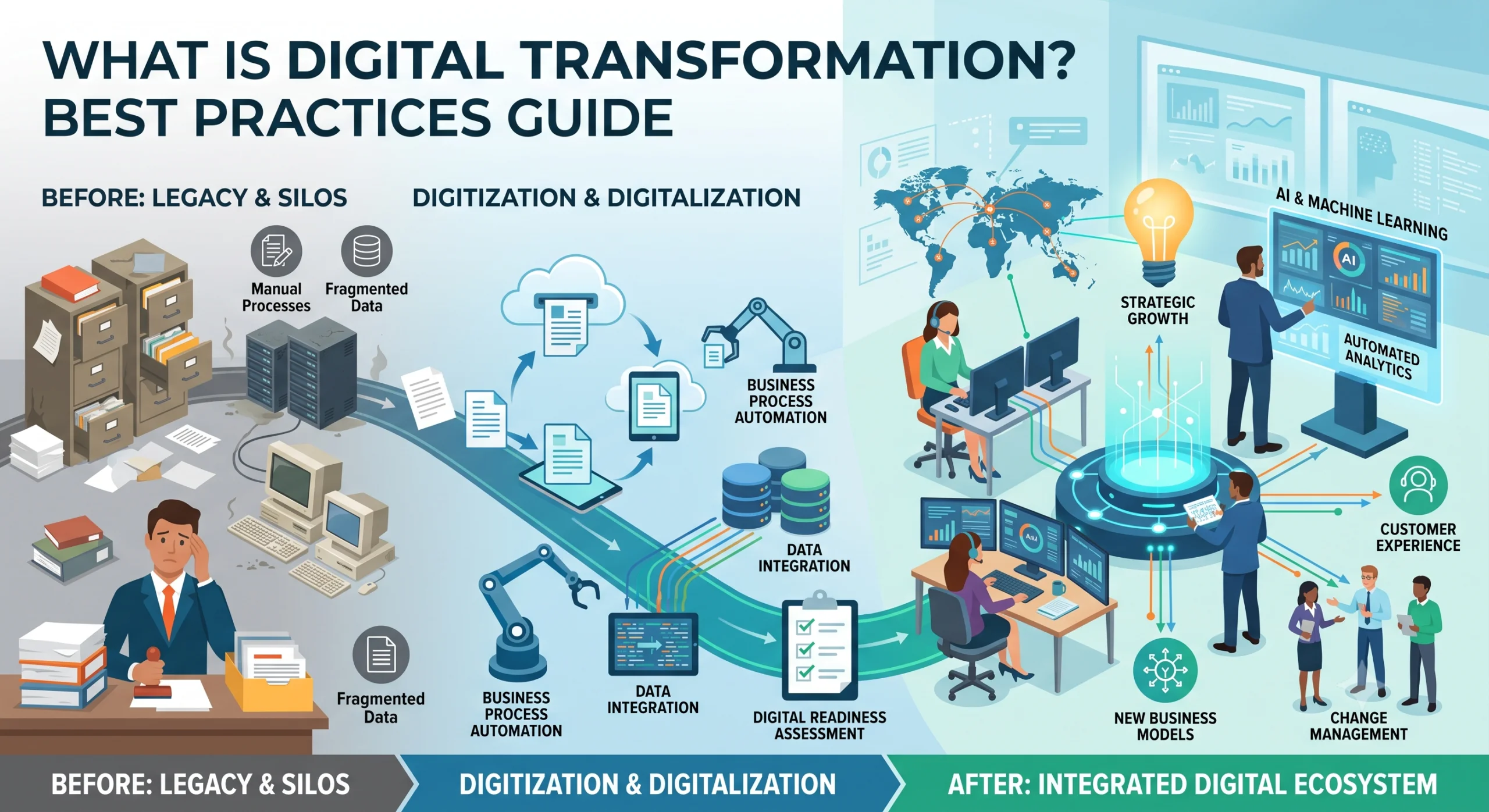
Digital transformation is the process of using digital technology to fundamentally change how a business operates and delivers value. Not how it stores documents. Not which apps it uses. How it operates.
The key word is fundamentally. If you scan paper invoices into PDFs, you have not transformed anything. You have moved the paper to a screen. If you rebuild your invoicing process so that invoices are generated, approved, sent, and reconciled automatically, and finance staff spend their time on exceptions instead of data entry, that is transformation.
Transformation changes the work, not just the format.
The Three Levels: Digitization, Digitalization, and Digital Transformation
These three terms get used interchangeably, and that causes confusion. They are different things.
Digitization is converting analog information to digital. Scanning a paper document into a PDF. Typing a handwritten ledger into a spreadsheet. The process does not change. Only the format does.
Digitalization is using digital technology to change or improve a process. Instead of mailing invoices, you email them. Instead of tracking inventory in a notebook, you use a database. The process is reworked to use digital tools, but the underlying business model stays the same.
Digital transformation is changing the business itself through digital technology. The processes change, the roles change, and sometimes the business model changes. A company that used to sell software as one-time licenses and now sells it as a subscription is not just digitalizing. The business has transformed.
Most companies stop at digitization or digitalization and call it transformation. It is not. If your finance team still does the same work in the same way, just on a screen instead of on paper, you have digitized. You have not transformed.
Common Mistakes Companies Make
We have seen the same mistakes repeat across projects. Here are the ones that derail transformations most often.
Starting With Technology Instead of Process
The most common mistake. A company buys software first, then tries to fit their processes into it. The software dictates the process, instead of the process dictating the software.
This fails because every company’s processes have reasons behind them. The way your operations team logs shipments, the way finance categorizes costs, the way HR tracks time, all of these evolved to handle real situations. When you force a new tool onto those processes without understanding them, you break things that were working and create new problems.
The right order: understand the process, identify what is broken or wasteful, then choose or build technology that fixes those specific problems.
Treating Transformation as an IT Project
Digital transformation touches every department. When it lives in the IT department and gets treated as a technology rollout, it fails. IT can build and maintain the systems, but the people who do the work have to define what the systems should do.
We have seen companies buy expensive platforms, hand them to IT to implement, and then wonder why adoption is near zero. The operations team was not involved. Finance was not involved. The tool does not match how they actually work.
Transformation is a business project with a technology component, not the other way around.
Trying to Do Everything at Once
The big bang approach. A company decides to transform everything, sets a deadline, and tries to replace all systems and processes simultaneously.
This fails for two reasons. First, no one can manage that much change at once. Second, when something breaks, and it will, you cannot isolate the cause. Was it the new system, the new process, the data migration, or the training gap? You will not know.
Phased transformation works. Pick the highest-pain process, transform it, learn, then move to the next.
Ignoring Data Quality
New systems on top of bad data produce bad results faster. We worked on a project where the legacy system had years of inconsistent supplier records. Duplicates, misspellings, missing fields. If we had built integrations on that data without cleaning it first, every report and sync would have propagated the errors.
Data cleanup is unglamorous and slow. It is also non-negotiable.
No Change Management
People do not resist technology. They resist change they did not ask for and do not understand.
We added an employee ID selection step to an operations workflow as part of an integration project. The team pushed back because no one explained why. Once we involved them in the design and showed them how the data fed into productivity dashboards they actually wanted, adoption followed.
If you do not plan for the human side, the technology side does not matter.
Best Practices
Start With Processes, Not Technology
Before you evaluate a single tool, map your current processes. Find the bottlenecks, the manual workarounds, the places where errors happen. Those are your transformation targets.
A good test: if you cannot describe the current process in detail, you are not ready to transform it. You are ready to disrupt it, which is different and usually worse.
Get Buy-In From the People Doing the Work
The people who do the work daily know where it breaks. They also know which proposed changes will help and which will create new problems.
Involve them early. Not as a formality after you have decided, but as input before you decide. Show them prototypes. Listen when they say something will not work. They are usually right.
Phase Your Approach
Pick one process or one system. Transform it. Measure the results. Learn what worked and what did not. Then apply those lessons to the next phase.
Phasing also gives you early wins you can point to. When the rest of the company sees a real improvement in one area, resistance to the next phase drops.
Measure Outcomes, Not Output
Output is easy to measure and often meaningless. How many tickets did the helpdesk close. How many reports were generated. These numbers go up whether or not the transformation worked.
Outcomes are harder to measure and actually matter. How much time does finance spend on manual entry. How fast can management see a financial discrepancy. How many errors reach the books before they are caught.
Define the outcomes before you start. Measure the baseline. Then measure again after each phase. If the numbers are not moving, the transformation is not working, regardless of how much technology you deployed.
Plan for Data From the Start
Data is the foundation. Before you build anything new, assess your data. Where does it live. How clean is it. Who owns it. What is missing.
Build data quality checks into every system you deploy. If data flows between systems, build reconciliation into the flow. Do not assume data will stay clean on its own. It will not.
How to Assess if Your Company Is Ready
Not every company is ready for transformation. Trying to force it before you are ready wastes money and creates cynicism that makes future attempts harder.
Ask these questions honestly.
Do you understand your current processes? If you cannot describe how work moves through your company today, you cannot transform it. You can only disrupt it.
Is your data in usable shape? If your core data is inconsistent, duplicated, or incomplete, transformation will amplify those problems. Clean first.
Do you have executive sponsorship? Transformation crosses department lines. Without someone at the top who can enforce decisions across departments, projects stall in politics.
Is your team willing to change? If the people doing the work are resistant or exhausted from previous failed initiatives, you need to address that before adding more change.
Do you have a clear problem to solve? “We need to digitize” is not a problem. “Finance spends 15 hours a week on manual data entry and errors reach the books” is a problem. Start with the second kind.
If you answered no to any of these, fix that first. Transformation forced on an unready company fails, every time.
The Role of Data, Automation, and Integration
Three technologies underpin most transformation work. Understanding their roles helps you deploy them where they matter.
Data
Data is the foundation. Every transformation decision, every automation, every dashboard, depends on data being accurate and accessible. If your data is scattered across spreadsheets and legacy systems with no consistency, nothing you build on top of it will be reliable.
Start by centralizing your core data. Define what the source of truth is for each data type: customer records, financial data, operational data, employee data. Then ensure every system respects that source of truth.
Automation
Automation removes repetitive manual work. It is most valuable where people are doing the same task repeatedly, where errors are common, and where the task follows predictable rules.
Automation is not valuable where judgment is required. Trying to automate a process that needs human decisions leads to systems that produce wrong results at high speed. Automate the rules, leave the judgment to people.
Integration
Integration connects systems so data flows between them without manual entry. This is where much of the transformation value lives, and where most companies have the biggest gaps.
We built an integration project for a major Sri Lankan import-export company where the legacy system could not talk to their bookkeeping or employee management systems. Staff retyped data between systems daily. The integration work, not any single new tool, is what reduced manual entry and errors.
Good integration has three properties:
- Idempotency: Running the same sync twice does not create duplicates.
- Reconciliation: You can compare what was sent against what landed.
- Error handling: Failures are visible, categorized, and recoverable.
Without these, integrations fail silently and create worse problems than manual entry did.
Examples of What Works and What Does Not
What Worked: Phased Integration With Process Mapping First
The import-export company project we mentioned. We spent weeks understanding the actual process, including the spreadsheets people used because the official system had gaps. Then we phased the migration and built integrations one at a time, with reconciliation and error handling from the start.
The result: manual data entry dropped, errors decreased, and management got real-time visibility for the first time.
What Did Not Work: Buying Software Before Mapping Process
A different company bought a project management platform to “transform” their operations. They did not map their process first. The platform imposed its own workflow structure. Within three months, the operations team had built a spreadsheet to track the things the platform could not handle, and the platform became a reporting tool no one trusted.
The tool was fine. The approach was wrong.
What Worked: Single Process, Measured Outcome
A company transformed its invoicing process. They mapped the current process, found that manual entry caused most of the errors, automated invoice generation from operational data, and measured the error rate before and after. Errors dropped, finance time on invoicing dropped, and the success gave them credibility to transform the next process.
FAQ
Is digital transformation the same as digitalization?
No. Digitalization improves a process using digital tools. Digital transformation changes the business itself, including processes, roles, and sometimes the business model. Scanning documents is digitization. Reworking how your business operates using digital technology is transformation.
How long does digital transformation take?
It depends on scope, but real transformation is not a project with an end date. It is a change in how the company operates. Individual phases, like integrating two systems or automating one process, take weeks to months. Full transformation across a company takes years and never really finishes, because the business and technology keep evolving.
Do we need to replace all our legacy systems?
No. Some legacy systems work well and should be integrated, not replaced. The decision depends on whether the system can integrate with your other tools, whether it handles your current needs, and whether maintaining it costs more than replacing it. We have built successful transformations that kept some legacy systems and replaced others.
What is the biggest risk in digital transformation?
People. Technology problems have technical solutions. People problems are harder. If the people who do the work are not involved, do not understand the change, and have no reason to support it, the transformation fails regardless of the technology.
Can small businesses do digital transformation?
Yes, and often more easily than large ones. Small businesses have fewer systems, fewer departments, and faster decision-making. The principles are the same: understand your process, solve a real problem, phase your approach, and manage the human side. Small companies just move through the phases faster.
Conclusion
Digital transformation is not about technology. It is about changing how your business works, with technology as the enabler. The companies that succeed at it are the ones that understand their processes before they change them, involve the people who do the work, phase their approach, and measure real outcomes.
The companies that fail are usually the ones that bought the tool first and figured out the process later.
At Helixz Solutions, we start every transformation project the same way: we understand the process before we write any code. It is slower at the start and faster where it counts. If you are considering a transformation project and want to talk through whether you are ready, that conversation is always free


