

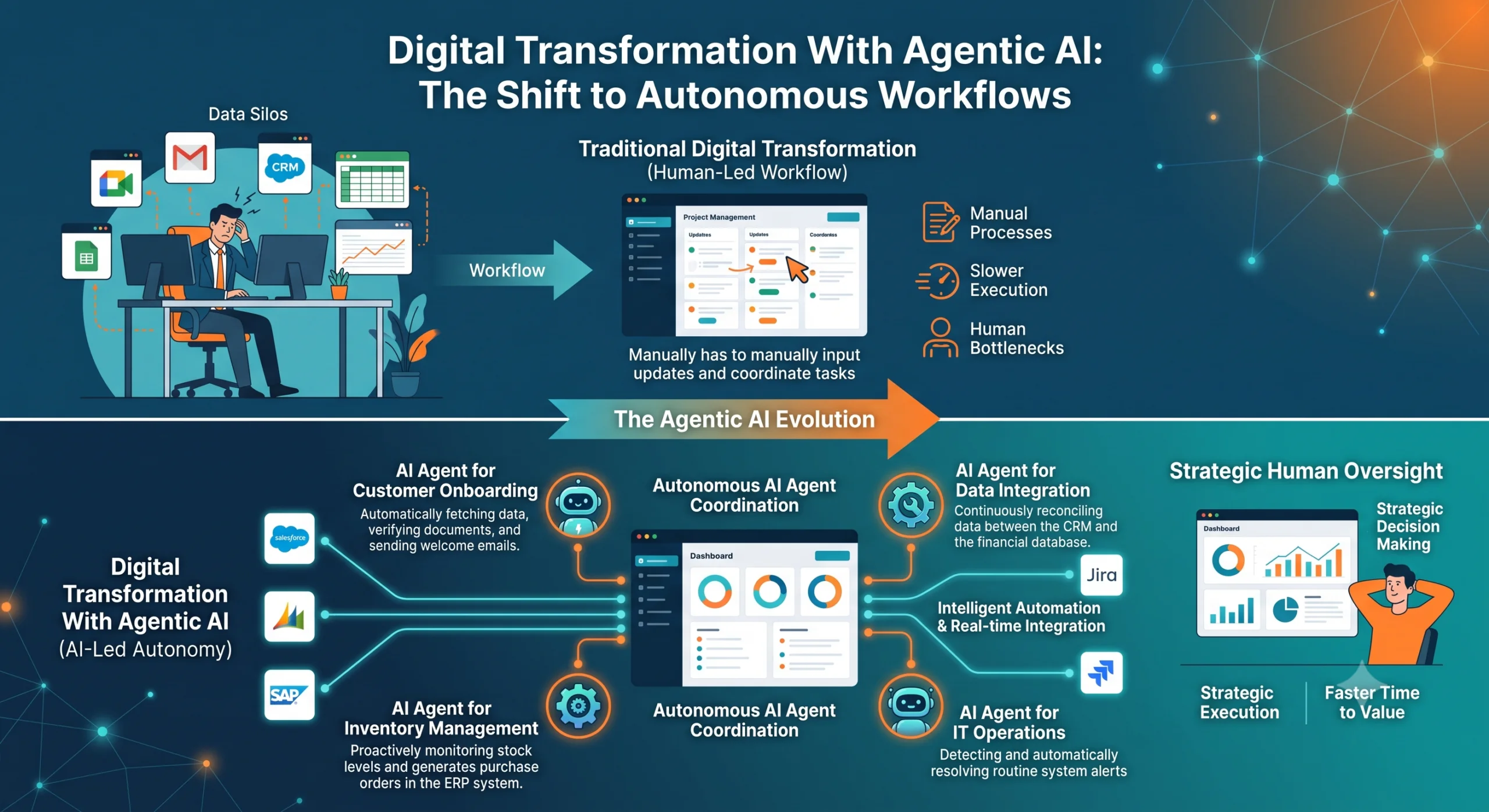
Digital Transformation With Agentic AI: What Changes and What Stays the Same
Every few years a new technology lands and the conversation around digital transformation resets. Cloud did it. Mobile did it. Generative AI did it. Now agentic AI is doing it, and the same questions come up at every client meeting we sit in on: Is this actually different? Do we have to rebuild what we just built? What stays the same?
We have spent the last two years building AI-driven platforms for Sri Lankan and international clients, and we want to give you a grounded answer. Not hype, not a pitch. A practical view of what agentic AI changes about digital transformation, what it leaves untouched, and where it makes sense to start.
What Agentic AI Actually Is
Agentic AI refers to AI systems that can plan, decide, and execute tasks with minimal human intervention. The key word is “execute.” A large language model can write you a draft. An agentic system can read a request, break it into steps, call the right tools or APIs, decide what to do with the results, and finish the task.
Think of the difference between a calculator and a junior accountant. The calculator does exactly what you tell it. The accountant understands the goal, figures out which calculations matter, asks questions when something is unclear, and produces a reconciled report. Agentic AI sits closer to the accountant than the calculator, though it is far from replacing either.
The components that make a system “agentic”:
- Planning: The model decomposes a goal into ordered steps.
- Tool use: It can call functions, query databases, hit APIs, or run code.
- Memory: It retains context across steps and sometimes across sessions.
- Decision making: It picks between options based on the results of previous steps.
- Action: It produces a real change in a system, not just text output.
Not every product that calls itself an “agent” has all five. Many are single-step prompt wrappers with a fancy UI. The distinction matters when you are evaluating vendors.
How Agentic AI Differs From Traditional Automation and Generative AI
Three categories get mixed up constantly. Here is how we separate them in practice.
Traditional automation (RPA, scripts, cron jobs)
These follow explicit, hard-coded rules. “If field X is empty, copy value from field Y.” They are deterministic, fast, and brittle. When the source system changes a field name, the script breaks and someone gets paged at 2am. Traditional automation is good for stable, repetitive work where the rules rarely change.
Generative AI (ChatGPT-style)
This produces content: text, images, code. It responds to a prompt with an output but does not act on its own. You ask, it answers. It cannot decide to go check a second system because the first one looked off. Generative AI is powerful for drafting, summarising, and transforming content, but it is reactive by design.
Agentic AI
This combines the flexibility of generative models with the ability to take action. An agentic system can receive a goal like “reconcile today’s invoice batch against the ledger,” plan the steps, fetch data from two systems, flag mismatches, draft correcting entries, and ask a human to approve before posting. The human is still in the loop, but the grunt work is gone.
The simplest way we explain it to clients: generative AI gives you an answer, agentic AI gets the job done.
Where Agentic AI Fits in a Digital Transformation Journey
Digital transformation is not a single project. It is a sequence of stages, and agentic AI fits into different points depending on where you are.
- Digitisation: Moving from paper to digital records. Agentic AI has little role here. You need clean data entry and stable storage first.
- Digitalisation: Connecting systems and automating workflows. This is where traditional automation and integration work live. Agentic AI can start to help with discovery and anomaly detection.
- Transformation: Rethinking how the business operates. This is where agentic AI earns its place, because the workflows are now fluid enough to support autonomous steps.
A mistake we see often: companies try to bolt agentic AI onto stage one. They have messy spreadsheets and disconnected systems, and they hope an agent will paper over the chaos. It will not. Agents amplify whatever state your data and processes are in. If that state is messy, you get fast, confident mess.
Practical Use Cases for Agentic AI
Let us get specific. These are use cases we have built or evaluated for clients.
Automated data reconciliation
Finance teams spend hours matching records between systems: bank statements against the ledger, sales orders against fulfilment data, vendor invoices against purchase orders. An agentic system can pull from both sources, apply matching rules, handle fuzzy matches on names and amounts, flag exceptions, and produce a reconciliation report with suggested adjustments. A human reviews the exceptions, not the whole batch.
Intelligent document processing
Traditional OCR pulls text from a scanned invoice. It does not know which number is the tax amount and which is the line total. An agentic pipeline can read the document, understand its structure, cross-reference against a vendor master record, validate totals, and route the invoice for approval, all without a person touching the document unless something looks wrong.
Autonomous monitoring and alerting
Instead of static thresholds (“alert if CPU > 90%”), an agentic monitor can look at patterns across metrics, correlate with recent deployments or external events, decide whether an alert is real or noise, and draft an initial incident summary. This reduces alert fatigue and shortens time to triage.
AI-assisted decision making
This is the one that needs the most care. An agent can pull sales data, market signals, and historical patterns, then present a ranked set of options with tradeoffs. It does not make the final call on a strategic decision. It compresses the research so a human can decide faster.
What Does NOT Change
This is the section most vendor decks skip. Here is what stays the same whether you adopt agentic AI or not.
- Clean data. Agents that reason over dirty data produce dirty conclusions. Data quality work is not optional. It is the foundation.
- Solid integrations. An agent that cannot reach your systems is just a chatbot. Integration work, API stability, and authentication all still matter.
- Clear processes. If humans do not know the correct workflow, the agent will not either. Document your processes before you automate them.
- Human oversight. Agents make mistakes. They hallucinate, they misjudge edge cases, they overstep. Every agentic workflow needs a human checkpoint for anything that touches money, customers, or compliance.
- Security and access control. An agent that can take actions needs scoped permissions, audit logs, and clear boundaries. “Let the AI do it” is not an access control policy.
We tell clients: agentic AI changes the speed and flexibility of transformation, not the prerequisites. If your data is a mess, your integrations are fragile, and your processes are undocumented, fixing those first will deliver more value than any agent.
Risks and Limitations
Agentic AI is powerful, and that power is exactly what makes it risky.
Hallucination
Models invent facts when they are uncertain. In a chatbot this is annoying. In an agent that posts journal entries it is dangerous. Mitigation: never let an agent write to a production system without validation against a source of truth, and never let it act on unverified assumptions.
Over-reliance
When agents handle routine work well, teams stop paying attention. Then when the agent hits an edge case it cannot handle, no one is around to catch it. Mitigation: keep humans in the loop on anything irreversible, and rotate staff through the manual path so they stay sharp.
Governance
Who is accountable when an agent makes a mistake? The vendor? The team that deployed it? The person who wrote the prompt? These questions need answers before deployment, not after an incident. Mitigation: define ownership, set boundaries for what the agent can do alone, and log every action for audit.
Cost and latency
Agents make multiple model calls per task. That adds up. A workflow that costs pennies in testing can become expensive at scale. Mitigation: measure cost per task, set budgets, and fall back to cheaper deterministic paths where the agent adds no value.
How to Start Small With Agentic AI
If you are mid-transformation and want to explore agentic AI, here is a low-risk path we recommend.
- Pick one painful, repetitive, reversible task. Reconciliation, document triage, or alert summarisation are good candidates. Avoid anything that touches customers or money directly on day one.
- Run it in shadow mode. Let the agent produce its output alongside the existing manual process. Compare results for a few weeks. Measure accuracy, time saved, and failure modes.
- Define the human checkpoint. Decide exactly what the agent can do alone and what needs approval. Write it down. Make it a checklist.
- Set guardrails on cost and access. Scope the agent’s permissions to only what it needs. Monitor token usage and error rates.
- Review and iterate. After a month, review what worked and what did not. Expand scope only when the current scope is stable.
- Document everything. Keep a log of decisions, failures, and fixes. This becomes your playbook for the next agentic workflow.
The goal is to build organisational muscle around agentic AI before you bet a critical process on it.
Examples: Real Scenarios We Have Seen
Scenario 1: The invoice pile
A mid-sized trading company received 200 to 400 invoices a day as PDFs and scanned images. Their finance team manually keyed each one into the ERP. We built an agentic document pipeline that extracts, validates, and routes invoices, with a human approving anything the system flags. Processing time dropped from days to hours, and the finance team shifted to exception handling instead of data entry.
Scenario 2: The midnight alert storm
A logistics client had a monitoring setup that fired 300 alerts a week, most of them noise. Staff ignored them, which meant the real incidents got missed too. We introduced an agentic layer that correlates alerts, suppresses duplicates, and drafts incident summaries. The team now sees 20 to 40 meaningful alerts a week, each with context attached.
Scenario 3: The reconciliation that never ended
A retail client reconciled daily sales across three systems: POS, e-commerce, and the warehouse system. Mismatches were common and chasing them took a full-time role. An agentic reconciliation system now pulls all three, matches transactions, handles currency and timing differences, and surfaces only the genuine exceptions. The reconciliation role moved to reviewing exceptions and investigating root causes.
FAQ
Is agentic AI the same as artificial general intelligence?
No. Agentic AI is a narrow system built to handle a specific set of tasks within defined boundaries. It can plan and act within its scope, but it does not have general reasoning or understanding outside that scope. It is a capable specialist, not a general intelligence.
Do we need to replace our existing automation with agentic AI?
No. Agentic AI works best alongside existing automation. Keep your deterministic scripts for stable, well-understood tasks. Use agents for the parts that need judgement, flexibility, or handling of unstructured input. A hybrid approach is more cost-effective than a full rip and replace.
How much data do we need before agentic AI is useful?
It depends on the use case. For document processing, you need enough examples to validate accuracy, which can be a few hundred documents. For decision support, you need enough historical data to identify patterns. The bigger question is data quality, not volume. Clean, well-structured data beats a large but messy dataset every time.
Can agentic AI replace a developer or analyst?
Not in the near term. It can take over repetitive, well-scoped parts of their work, which frees them for higher-value tasks. The judgement, domain knowledge, and accountability still rest with people. Think of it as a capable assistant, not a replacement.
What is the biggest risk of adopting agentic AI too early?
Bolting agents onto a broken foundation. If your data is inconsistent, your integrations are fragile, and your processes are undocumented, agentic AI will make the problems faster and harder to trace. Fix the foundation first, then layer in agents where they add real value.
Conclusion
Agentic AI is a real shift in what digital transformation can deliver. It moves automation from rigid rules to flexible, goal-oriented workflows. It can reduce manual work, speed up reconciliation, and make monitoring meaningful. But the fundamentals of a good transformation do not change. Clean data, solid integrations, clear processes, and human oversight are still the foundation. The agents are only as good as the ground they stand on.
If you are considering where agentic AI fits in your transformation, start with one painful, reversible task. Run it in shadow mode. Keep a human in the loop. Learn what works before you scale. That is the path we have seen succeed, and it is the one we follow ourselves.


